
Can You Pour Concrete in Freezing Weather?
Yes, concrete can be poured in freezing weather if it is kept from freezing until it has gained strength. NRMCA says fresh concrete should be protected from freezing until it reaches 500 psi, about two days after placement. Concrete that freezes before then can lose more than half of its potential strength.
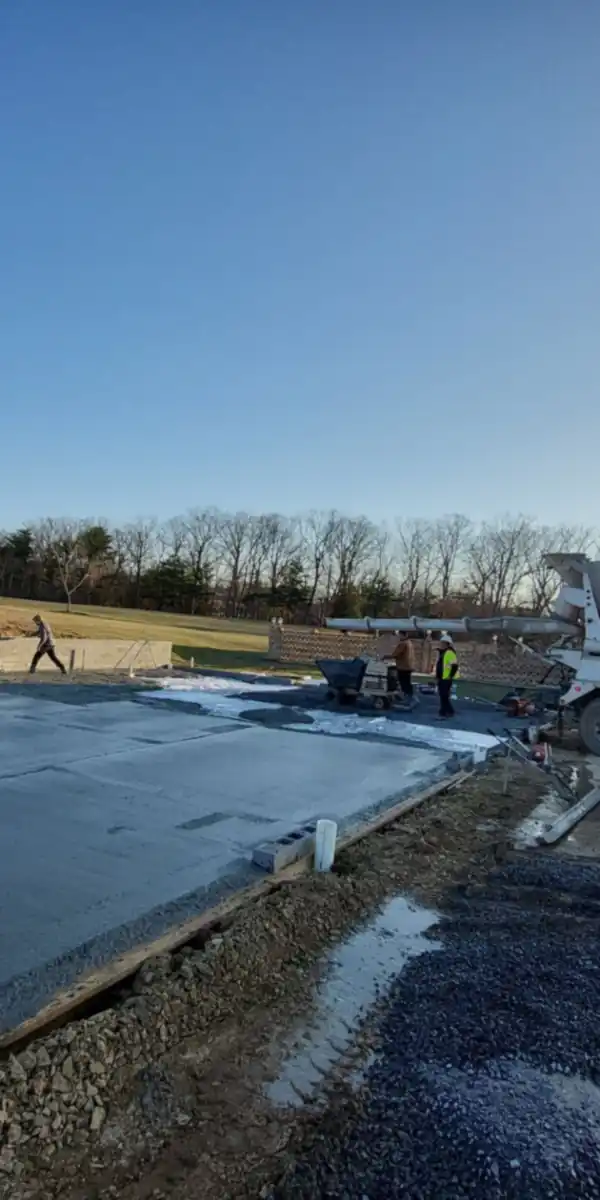
Our crew places a large slab straight from the mixer truck.
- PA Home Improvement Contractor registration PA144609
- Fully insured
- Workmanship covered for one year
- Serving Central Pennsylvania since 2018
What Counts as Cold Weather for Concrete?
NRMCA defines cold weather as more than three days in a row averaging under 40 F. The air must also stay at or below 50 F for more than half of each day (CIP 27). Our crews keep working through the winter, so these limits shape how we pour then. Fresh concrete freezes when its own temperature falls below about 25 F (CIP 27). NRMCA advises keeping placed concrete above 50 F while it cures (CIP 11). Winter pours are planned with care across the hardscapes we design and build.
What Happens When Fresh Concrete Freezes?
Fresh concrete is full of water, and that water expands as it freezes. NRMCA says frozen concrete can lose more than 50 percent of its potential strength and will not be durable (CIP 27). A surface that freezes early is weakened and can dust (CIP 1). Newly placed concrete is saturated and should be kept from freeze-thaw cycles until it reaches 3,500 psi (CIP 27). Deicing salt on new concrete makes scaling worse (CIP 2).
How Do You Protect Concrete From Freezing?
Protecting concrete from freezing means keeping its temperature up while it gains strength. NRMCA lists the main ways in its cold-weather sheet. Five of them matter most on home slabs.
- Order warmer concrete from the ready mix plant, at least 55 F as placed for slabs under 12 inches thick (CIP 27).
- Use an accelerating admixture to speed setting, knowing it does not stop the concrete freezing (CIP 27).
- Cover the slab with insulating blankets, which hold in the heat the concrete makes as it hardens (CIP 27).
- Never pour on frozen ground or over snow and ice (CIP 4).
- Use membrane curing compounds or plastic sheets rather than water curing when freezing is near (CIP 27).
In freezing weather our crews cover fresh concrete with blankets.
How Long Must New Concrete Be Kept From Freezing?
New concrete must be kept from freezing until it reaches 500 psi, about two days after placement, NRMCA says (CIP 27). New concrete needs protection until it is strong enough to resist frost. Cold concrete sets and gains strength slowly, so the protection may need to stay on longer (CIP 27). Blankets come off gradually, since the surface and the core should not differ by more than about 35 F (CIP 27). Forms may stay on for 1 to 7 days, depending on strength gain and weather (CIP 27).
What Are the Signs of Frozen Concrete?
Concrete that froze early shows it at the surface first. Look for two signs once it thaws.
- A soft, powdery surface scratches easily or rubs off, which NRMCA calls dusting (CIP 1).
- The top layer flakes or peels, often after the first freeze-thaw cycles, which NRMCA calls scaling (CIP 2).
Rain at the wrong time causes similar surface damage, explained on our page about fresh concrete and rain.
Who Pours Concrete Year-Round in Central PA?
UDA Services crews keep working through the winter. A winter pour is best planned at the free site visit. Three reasons support a winter pour with us.
- Our registration as a PA Home Improvement Contractor, PA144609, sits alongside full insurance.
- We have about 310 projects behind us since 2018.
- Our workmanship is covered for one year.
See how a slab goes in on our concrete patios page.
Jake and his team completed the concrete upgrade for our pool in 2020 and this spring completed a project renovating our deck and turning it into an enclosed porch/sunroom, with new concrete patio and steps to our pool. From start to finish, they were dependable and meticulous. Jake took our ideas and vision and made it a reality, offering suggestions along the way. Both projects were done in a timely manner. Highly recommended and we plan to use UDA Services again soon for our next project.
What Else Do Homeowners Ask About Winter Concrete?
Homeowners also ask about salt on new concrete and about curing time. Two short answers follow.
Can You Salt New Concrete in Its First Winter?
No, you cannot safely salt it: NRMCA advises keeping deicing chemicals off new concrete, which is still saturated and weaker (CIP 2). It also warns that magnesium-based road salts tracked in by cars can damage the surface.
How Long Does Concrete Take to Cure in Winter?
Concrete cures more slowly in winter than the about 28 days Concrete Network gives for mild weather. By the NRMCA rule of thumb, each 20 F drop in concrete temperature roughly doubles the setting time (CIP 27). Read how long a concrete cure takes in any season.
- PA Home Improvement Contractor registration PA144609
- Fully insured
- Workmanship covered for one year
- Serving Central Pennsylvania since 2018