
Can You Pour a Concrete Slab Directly on Soil?
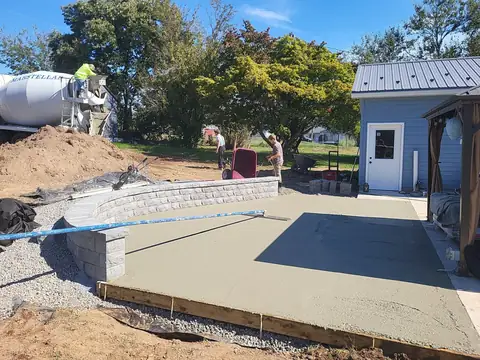
Yes, concrete can go on soil, but only on firm, compacted soil with the topsoil and soft spots removed. NRMCA says the soil under a slab should be compacted soil or granular fill. We build our own driveways and patios on a compacted gravel base, as our job photos show.
This gravel base was spread and leveled inside the forms before the pour.
- PA Home Improvement Contractor registration PA144609
- Fully insured
- Workmanship covered for one year
- Serving Central Pennsylvania since 2018

What Must Happen to Soil Before Concrete Goes On?
The topsoil and soft spots should be removed from the subgrade, the ground the slab rests on, NRMCA says (CIP 4). The soil left should be compacted by rolling, vibrating or tamping, and sloped so water drains. A smooth, level and uniformly compacted subgrade helps prevent cracking, NRMCA adds. Ground work comes first on every hardscape we build.
Five steps prepare the ground.
- Strip the topsoil, roots and soft spots down to firm ground.
- Compact the soil that is left by rolling, vibrating or tamping.
- Slope the subgrade so water drains away from the slab.
- Spread and compact a crushed stone base inside the forms.
- Clear any snow and ice, and wait out wet spots before the pour.

Why Put a Gravel Base Under a Slab?
A gravel base is a compacted layer of crushed stone between the soil and the concrete. It is the granular fill NRMCA names as a bed for a slab. For concrete paving, the American Concrete Pavement Association names expansive soils and frost heave as the soil problems that need particular attention. It adds that a base layer helps give uniform support, while careful subgrade preparation is the best way to get it. Our own driveways and patios are poured on compacted gravel inside wood forms.


What Happens When a Slab Is Poured on Bad Soil?
A slab on soft or uneven soil settles where the soil gives way. NRMCA lists improper subgrade preparation among the causes of cracking (CIP 4). Two results follow from it.
- Settlement cracks open where part of the slab loses its support and sinks.
- The slab bends under load wherever the soil beneath it gives.
NRMCA adds that most early random cracks, though unsightly, rarely affect structural integrity (CIP 4).
Should Concrete Go on Frozen or Wet Ground?
No, NRMCA says concrete should never be placed on a frozen subgrade (CIP 4). Snow and ice are cleared first, and wet spots in the subgrade are avoided. NRMCA also warns against placing concrete on a cold subgrade, not only a frozen one (CIP 14). In hot, dry weather it suggests lightly dampening the subgrade, without leaving puddles (CIP 1). Winter pours carry more risks, set out on our page about how to pour concrete in freezing weather.
Does a Slab Need a Vapor Barrier Under It?
No for most slabs, but yes for an interior slab under floor coverings, in NRMCA's guidance (CIP 1). A vapor retarder is a plastic sheet laid under a slab to slow ground moisture rising into it. It matters mostly under slabs inside the house. NRMCA advises against placing concrete straight on plastic for most slabs (CIP 1). It suggests 3 to 4 inches of compactible fill over the sheet instead. A vapor retarder right under a slab increases bleeding and the potential for cracking, NRMCA notes (CIP 4). Interior slabs that will get floor coverings are the exception NRMCA names (CIP 1).
Who Pours Concrete Slabs and Pads in Central PA?
UDA Services prepares the ground and pours slabs, pads, patios and driveways across Central PA. Our crew prepares the ground and the drainage before each pour. Three facts stand behind the work.
- Full insurance and PA Home Improvement Contractor registration PA144609 back every pour.
- We have about 310 projects behind us since 2018.
- Our workmanship is covered for one year.
A shed or a hot tub needs a level base like the concrete slabs and pads we pour.
Jake and his team completed the concrete upgrade for our pool in 2020 and this spring completed a project renovating our deck and turning it into an enclosed porch/sunroom, with new concrete patio and steps to our pool. From start to finish, they were dependable and meticulous. Jake took our ideas and vision and made it a reality, offering suggestions along the way. Both projects were done in a timely manner. Highly recommended and we plan to use UDA Services again soon for our next project.
What Else Do Homeowners Ask About Slabs and Soil?
Homeowners also ask about pavers on soil and about rain after the pour. Two short answers follow.
Can Pavers Go Straight on Soil?
No, pavers cannot go straight on soil; they need a compacted gravel base and a sand bedding layer to stay level. Our paver patios sit on a compacted gravel base. See how the base is built on our paver patio installation page.
Does Rain on the Soil Before a Pour Matter?
Yes, a soaked subgrade is soft, and NRMCA advises avoiding wet spots (CIP 14). A pour is best held until the ground has firmed up again.
- PA Home Improvement Contractor registration PA144609
- Fully insured
- Workmanship covered for one year
- Serving Central Pennsylvania since 2018