
What Happens If It Rains on Fresh Concrete?
Rain on fresh concrete weakens and marks the surface when it falls before the concrete is finished and set. Once the surface has set, light rain does little harm and even helps keep the slab moist. NRMCA lists poor protection from rain among the causes of a dusty, weak surface, so plan each pour with cover on hand.
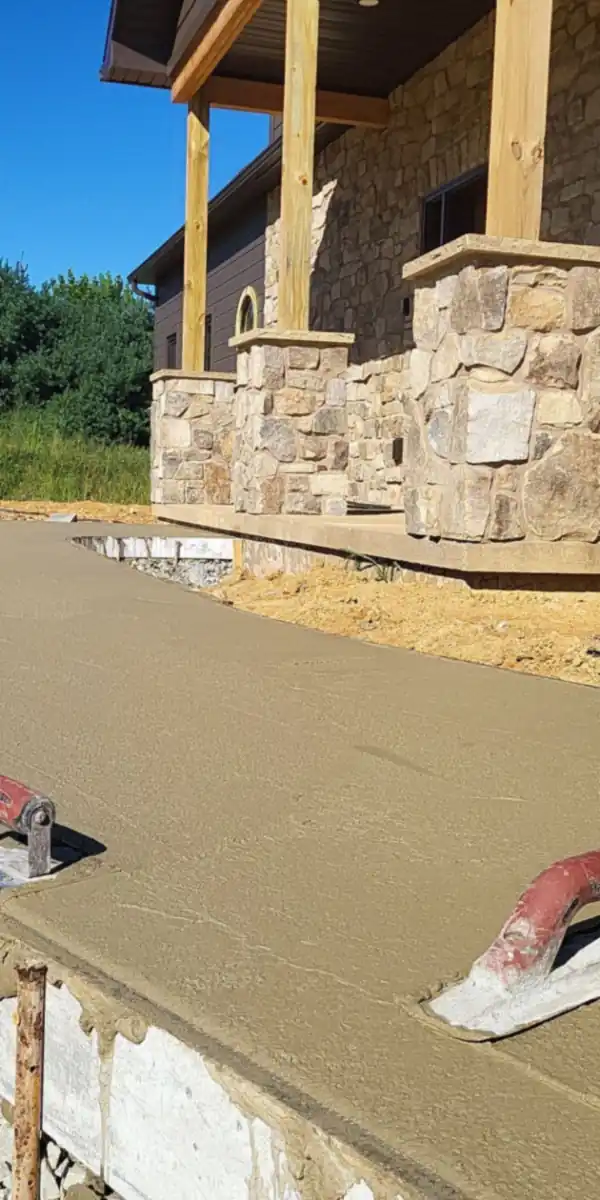
This fresh concrete walk is still being hand-floated, a stage when rain can mark the surface.
- PA Home Improvement Contractor registration PA144609
- Fully insured
- Workmanship covered for one year
- Serving Central Pennsylvania since 2018
Why Is Rain a Problem for Fresh Concrete?
Fresh concrete is concrete that has been placed but has not yet set hard. Its strength depends on the ratio of water to cement in the mix. Rain adds water to the top layer, so that layer ends up weaker than the slab below. Extra water worked into the top quarter inch gives a very high water-cement ratio and a weak surface, NRMCA notes (CIP 1). NRMCA also links finishing while water sits on the surface to scaling (CIP 2). Good protection is part of the hardscapes we design and build.
How Does Rain Damage Concrete at Each Stage?
The harm rain does depends on the stage the concrete has reached, not on the clock alone. Concrete moves from placed, to bleeding, to finished, to set, to curing. The table shows what rain does at each stage.
| Stage | What rain does | What to do |
|---|---|---|
| Placed, before finishing | Mixes into the top and can wash out paste | Cover it, and do not finish while water sits on top (CIP 14) |
| Bleeding, water sheen on the surface | Adds to the water already rising | Wait for the sheen to go before floating (CIP 14) |
| Finished but not set | Pits, marks or a weak surface that later dusts | Cover with plastic sheeting (CIP 1, CIP 11) |
| Set and curing | Little harm; moisture helps curing | Keep it moist for 3 to 7 days (CIP 11) |
Source: NRMCA, Concrete in Practice sheets CIP 1, 11 and 14, read 2026-10-13.
Does Rain After 2, 4, 8 or 12 Hours Hurt Concrete?
Yes, rain hurts concrete at any of those hours if it has not yet set. There is no single safe number of hours, because temperature sets how fast concrete sets. The NRMCA rule of thumb is that a 20 F drop in concrete temperature roughly doubles the setting time (CIP 27). So concrete that feels hard after a few hours on a warm day may still be soft on a cool one. The safer test is the surface: NRMCA times final finishing for when a footprint sinks only 1/8 to 1/4 inch (CIP 14). The longer the gap before the rain and the warmer the day, the further the set has gone.
How Do You Protect Fresh Concrete From Rain?
Protecting fresh concrete from rain means keeping water off the surface until it has set. Plastic sheeting laid over the slab is the usual cover. Five steps keep a new pour safe when rain threatens.
- Check the forecast and move the pour if heavy rain is due.
- Keep plastic sheeting at least 4 mils thick, to ASTM C171 (CIP 11), on site before the truck arrives.
- Weigh the edges down so wind cannot lift them.
- Keep the sheet clear of the surface where it would mark the finish, using boards or stakes at the edges.
- Uncover once the rain passes and keep curing the slab.
Never sprinkle dry cement on a wet surface to soak up the water, a practice NRMCA warns causes dusting (CIP 1).
How Can You Tell If Rain Damaged Your Concrete?
You can tell from the top layer, since rain damage shows there, not through the slab. Look for three signs once the surface is dry.
- Dusting is a powder that rubs off under traffic or a broom.
- Crazing is a network of fine cracks across the top of the slab.
- Scaling is flaking of the finished surface that may appear after the first winter.
The damage sits in the top layer, and NRMCA notes that craze cracks are rarely more than 1/8 inch deep (CIP 3).
Can Rain-Damaged Concrete Be Repaired?
Yes, light surface damage can usually be repaired without replacing the slab. Repair means removing the weak top layer and bonding a new surface to sound concrete. NRMCA lists thin bonded resurfacing, such as portland cement or polymer-modified repair mortar, for light to moderately scaled surfaces (CIP 2). A dusting floor can be treated, or in severe cases wet-ground back to sound concrete. Severe damage may mean breaking out the slab and pouring again.
Can You Pour Concrete in the Rain?
No, pouring during rain is best avoided, because the surface cannot be finished well while water falls on it. Finishing over standing water leads to dusting, scaling and crazing (CIP 14). A light shower after the pour can be handled with covers. A pour in steady rain is usually moved to a dry day. Cold rain brings its own risks, and our guide explains how to pour concrete in freezing weather safely.
Who Pours Concrete Patios and Driveways in Central PA?
UDA Services pours concrete patios, driveways, walks and slabs for homes across Central PA. Every job starts with a free site visit and a written estimate. Three facts stand behind that work.
- We hold PA Home Improvement Contractor registration PA144609 and full insurance.
- We have completed about 310 projects since 2018.
- Our workmanship is covered for one year.
See how a slab goes in on our concrete patio installation page.
Jake and his team completed the concrete upgrade for our pool in 2020 and this spring completed a project renovating our deck and turning it into an enclosed porch/sunroom, with new concrete patio and steps to our pool. From start to finish, they were dependable and meticulous. Jake took our ideas and vision and made it a reality, offering suggestions along the way. Both projects were done in a timely manner. Highly recommended and we plan to use UDA Services again soon for our next project.
What Else Do Homeowners Ask About Rain and New Concrete?
Homeowners also ask about curing time, sealer and walking on a wet slab. Quick answers follow.
Is Rain Good for Curing Concrete?
Yes, once the surface has set, moisture from light rain helps the slab cure. NRMCA notes that concrete kept dry can lose as much as half of its potential strength (CIP 11). Our page explains how long concrete takes to cure before it reaches full strength.
What If It Rains on Freshly Sealed Concrete?
Sealer is applied to cured concrete, so rain on new sealer is a separate question. The sealer label states how long it must dry before rain. Our page on how long concrete sealer should dry before rain covers it.
Can You Walk on Concrete After It Rains?
Yes, you can walk on it once a footprint no longer marks the surface, whether or not it rained. What matters is how far the concrete has set, not the rain.
- PA Home Improvement Contractor registration PA144609
- Fully insured
- Workmanship covered for one year
- Serving Central Pennsylvania since 2018